
The IAEA Marie Skłodowska-Curie Fellowship Programme 2027 offers funding to young women pursuing a master’s degree in a nuclear-related field. The programme provides financial support for tuition and living expenses, making it a useful opportunity for students interested in nuclear science, technology, and related areas.
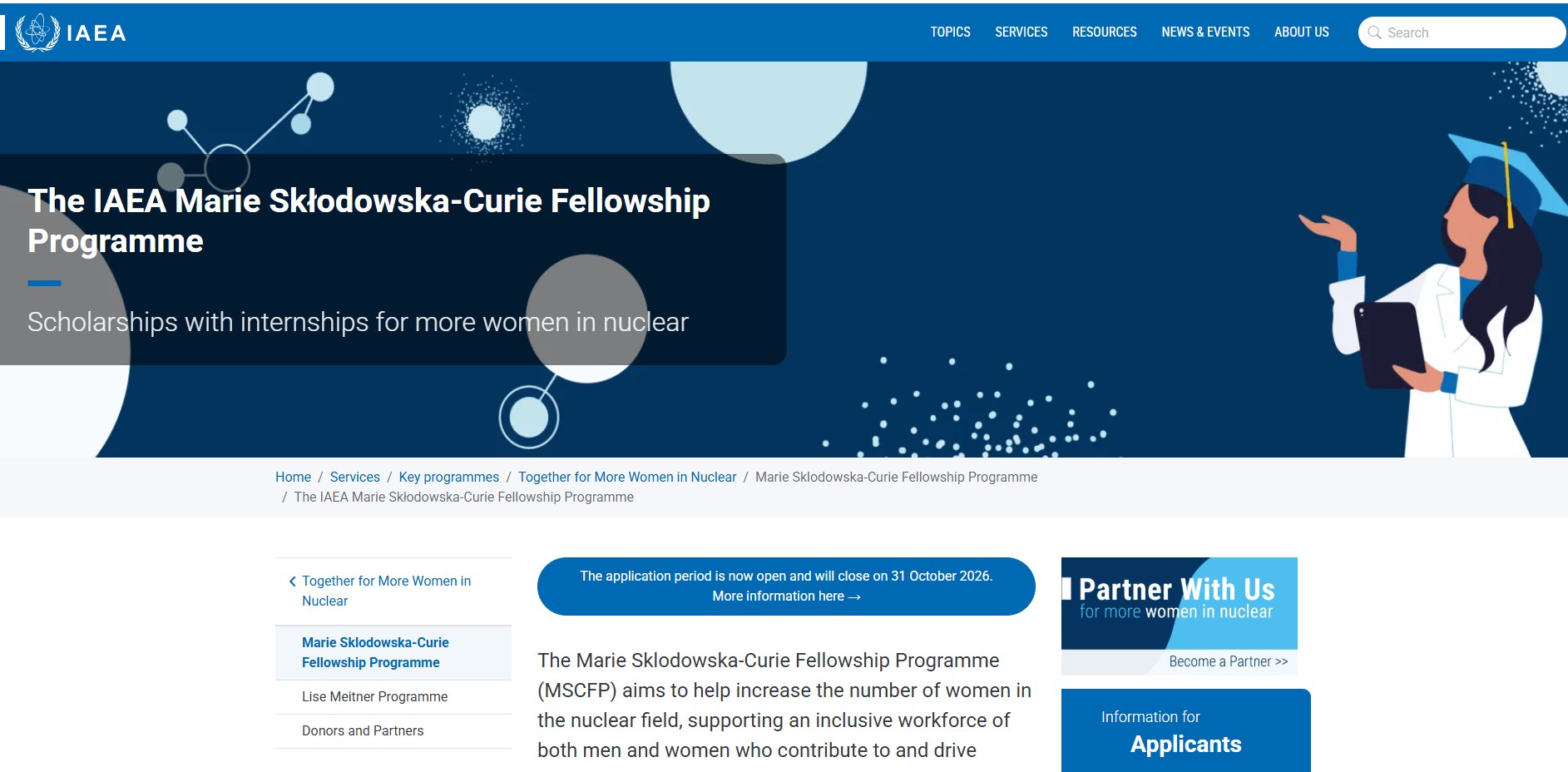
The fellowship is offered by the International Atomic Energy Agency (IAEA) as part of its effort to encourage more women to build careers in the nuclear sector. For the 2027 cycle, applications are expected to close on October 31, 2026.
About the IAEA Marie Skłodowska-Curie Fellowship
The IAEA Marie Skłodowska-Curie Fellowship Programme supports female students from IAEA Member States who are studying or have been accepted into a master’s programme in a nuclear-related field.
Applicants can study at an accredited university, provided that their programme falls within an area relevant to the IAEA’s work.
The programme has supported students in fields such as nuclear engineering, nuclear physics and chemistry, nuclear medicine, radiation biology, nuclear safety and nuclear security.
Benefits of the Fellowship
Selected students can receive:
- Up to €20,000 toward tuition costs.
- Up to €20,000 toward living expenses.
- Opportunities for professional development and networking.
- Opportunities connected to the IAEA’s nuclear science and technology activities.
The total potential support can therefore reach €40,000 for the master’s programme, depending on the award and eligible costs.
Eligibility Requirements
Applicants generally need to meet the following requirements:
- Be a female candidate.
- Be a citizen of an IAEA Member State.
- Have been accepted into, or already be enrolled in, an accredited master’s programme.
- Be studying a nuclear-related field relevant to the IAEA.
- Have good academic credentials. Previous programme information indicates preference for applicants with academic results of at least 75% or a GPA above 3.0/4.0.
Check the exact requirements on the official IAEA application page before applying.
Fields of Study
Eligible areas can include:
- Nuclear engineering
- Nuclear physics
- Nuclear chemistry
- Nuclear medicine
- Radiation biology
- Nuclear safety
- Nuclear security
- Nuclear law
- Non-proliferation
- Isotopic techniques
Meanwhile, other closely related fields may also be considered.
Documents Needed for IAEA Marie Skłodowska-Curie Fellowship Programme 2027
Applicants should be prepared to provide documents such as:
- Passport or national identification document
- Official university admission or acceptance letter
- Confirmation of tuition costs
- Information about any other scholarships received
- Reference forms submitted by referees
Application documents are required in English, or should be accompanied by an appropriate English translation where necessary.
How to Apply IAEA Marie Skłodowska-Curie Fellowship Programme 2027
Applications are submitted through the IAEA’s online application process.
Applicants should first confirm that their master’s programme meets the nuclear-related field requirement. They should then prepare their admission letter, tuition information, identification document, and references before completing the online application.
It is important to submit all required documents before the deadline because incomplete applications may not be considered.
IAEA Marie Skłodowska-Curie Fellowship Deadline
The listed deadline for the 2027 programme is October 31, 2026.
Applicants should still check the IAEA’s official programme page for the latest deadline and application instructions before submitting.
Official Fellowship Page
For more information concerning this programme, kindly click on the link below to visit their official page.
IAEA Marie Skłodowska-Curie Fellowship Programme
Frequently Asked Questions
Is the IAEA Marie Skłodowska-Curie Fellowship fully funded?
The programme can provide up to €20,000 toward tuition and up to €20,000 toward living expenses. The exact award depends on the individual fellowship arrangements.
Who can apply?
The programme is aimed at female students from IAEA Member States who are pursuing a master’s degree in a nuclear-related field.
Can I study at any university?
The programme supports master’s studies at accredited universities, provided the course meets the programme’s field requirements.
CHECK THESE OUT:
Coro Fellowship in Public Affairs 2027: Tuition-Free Fellowship for Emerging Leaders
TWAS PhD Fellowships 2026 – Fully Funded
Fernand Braudel Senior Fellowships 2026: Eligibility, €3,200 Stipend and Application Deadline
CHCI NextGen Latino Leadership Program 2027: Free Washington, D.C. Leadership Opportunity…